

H-beams and I-beams are essential components in construction and engineering, and understanding the differences in the h beam vs i beam comparison is crucial. These beams differ in shape, structure, and functionality. An H-beam has a wider flange and a thicker web, making it ideal for heavy loads. In contrast, an I-beam features a narrower flange and thinner web, which suits lighter applications. You often see these beams in bridges, buildings, and other structural projects. Choosing the right beam ensures stability and efficiency in your construction work. Understanding the differences between an H-beam and an I-beam helps you make informed decisions for your projects.
Key Takeaways
- H-beams have wider edges and thicker centers. They are great for heavy loads in big structures like bridges and factories.
- I-beams are lighter and cheaper. They work well for houses and small projects.
- Picking the right beam is important for safe and strong buildings.
- H-beams are very strong and can cover long spaces without extra help. I-beams are better for holding up weight from above.
- Think about your project’s needs to choose the best beam for the job.
Structural Differences in H-Beams and I-Beams

Cross-Section Design
Shape and appearance of H-beams
H-beams, as the name suggests, have an H-shaped steel cross-section. This design features wide, flat flanges that run parallel to each other, connected by a thick web in the middle. The uniformity in flange width and web thickness gives H-beams a robust and symmetrical appearance. These beams are ideal for applications requiring even load distribution, such as bridges and industrial structures. The wide flanges also make them suitable for spanning longer distances without additional support.
Shape and appearance of I-beams
I-beams, on the other hand, have a distinct I-shaped cross-section. Their flanges are narrower and often tapered, with a thinner web connecting them. This design optimizes material usage, making I-beams lighter and more cost-effective. However, the thinner web and flanges limit their ability to handle heavy loads. I-beams are commonly used in lightweight structures and residential construction projects where vertical load resistance is the primary requirement.
| Beam Type | Cross-Section Shape | Flange Design | Web Thickness | Load-Bearing Capacity | Applications |
|---|---|---|---|---|---|
| H-Beam | H-shaped | Wide, flat flanges | Thick | High, distributes loads evenly | Large buildings, bridges, industrial projects |
| I-Beam | I-shaped | Narrow, tapered flanges | Moderate | Effective for vertical loads | Lightweight buildings, medium-sized structures |
Flange and Web Thickness
Flange and web thickness in H-beams
H-beams are designed with thicker flanges and webs, which enhance their structural integrity. The thicker web provides superior resistance to vertical forces, making these beams suitable for high-load environments like bridges and large buildings. Additionally, the wide flanges improve the beam’s ability to handle bending and shear forces, ensuring stability in demanding applications.
- H-beams excel in heavy bending load scenarios.
- Their thicker web offers enhanced shear capacity.
- These beams can span longer distances without compromising strength.
Flange and web thickness in I-beams
I-beams have thinner flanges and webs compared to H-beams. While this design reduces weight and material costs, it also makes I-beams more prone to lateral buckling and shear failure under heavy loads. Despite these limitations, I-beams perform well in projects with moderate vertical load requirements, such as residential buildings.
- I-beams are lighter and more cost-effective.
- Their thinner web limits their ability to resist heavy bending loads.
- Additional supports may be needed for high-stress applications.
Dimensions and Weight
Weight distribution in H-beams
H-beams distribute weight more evenly due to their wider flanges and thicker web. This design results in a higher moment of inertia, allowing the beam to resist bending and deflection effectively. The uniform thickness of the flanges also contributes to their ability to handle heavy loads over long spans.
Weight distribution in I-beams
I-beams, with their narrower flanges and thinner web, focus on vertical load resistance. This design makes them lighter and easier to handle, but it also reduces their overall load-bearing capacity. I-beams are best suited for projects where minimizing weight is a priority, such as lightweight steel beams in residential construction.
| Beam Type | Flange Width | Web Thickness | Load-Bearing Capacity |
|---|---|---|---|
| H-beam | Wider | Thicker | Higher |
| I-beam | Thinner | Thinner | Lower |
Manufacturing Process
How H-beams are manufactured
H-beams undergo a more intricate manufacturing process compared to I-beams. Specialized rolling machines shape the steel into the characteristic H-profile. These machines ensure precise control over the dimensions, maintaining uniform thickness across the flanges and web. This precision is crucial for the beam’s ability to handle heavy loads and span long distances.
The process begins with rectangular steel slabs. These slabs are heated and passed through specialized rolls that mold them into the H-shape. The machinery used in this process allows for greater flexibility in size and shape, making H-beams suitable for a wide range of applications. The complexity of this process results in higher production costs but ensures superior structural performance.
Key features of H-beam manufacturing include:
- Specialized rolls maintain straightness and uniform thickness.
- Rolling machines allow precise control of dimensions.
- The process offers flexibility in size and shape.
| Feature | H-Beams |
|---|---|
| Manufacturing Complexity | More complex, allowing for size flexibility. |
| Rolling Process | Requires precise control for uniform thickness. |
| Machinery | Involves specialized machinery for precision. |
How I-beams are manufactured
I-beams are produced using a simpler and more cost-effective process. Standard rolling mills shape the steel into the I-profile. This process involves fewer steps and less specialized machinery, making it more efficient for mass production.
The manufacturing process starts with rectangular steel slabs. These slabs are heated and rolled into the I-shape using standard production lines. The simplicity of this process reduces production costs, making I-beams an economical choice for lightweight construction projects.
Key features of I-beam manufacturing include:
- Standard rolling mills form the I-shape.
- The process uses rectangular slabs, simplifying production.
- Lower production costs make I-beams more affordable.
| Feature | I-Beams |
|---|---|
| Manufacturing Complexity | Simpler, resulting in lower production costs. |
| Rolling Process | Standard rolling mills form the I-shape. |
| Machinery | Produced using standardized production lines. |
By understanding these manufacturing differences, you can better appreciate the unique characteristics of H-beams and I-beams and their suitability for various construction needs.
Material Properties of H-Beams and I-Beams
Strength and Durability
Load-bearing capacity of H-beams
H-beams excel in load-bearing applications due to their robust design. The wide flanges and thick web of these h-shaped steel beams provide exceptional strength, allowing them to handle both vertical and lateral forces effectively. This makes H-beams ideal for large-scale projects like bridges and high-rise buildings, where stability and durability are critical. Their cross-sectional properties ensure even weight distribution, reducing the risk of structural failure under heavy loads.
Load-bearing capacity of I-beams
I-beams, with their narrower flanges and thinner web, are better suited for projects requiring vertical load-bearing columns. These steel beams perform well in lightweight structures, such as residential buildings, where the primary focus is on resisting vertical pressure. However, their design limits their ability to handle lateral forces, making them less suitable for heavy-duty applications compared to H-beams.
Flexibility and Rigidity
Flexibility of H-beams
H-beams prioritize rigidity over flexibility. Their broader flanges and thicker web enhance their resistance to bending and twisting forces. This rigidity ensures stability in demanding environments, such as industrial structures and bridges.
H-beams have strong lateral and vertical load-bearing capacities, making them suitable for large buildings, bridges, and high-rise structures.
Rigidity of I-beams
I-beams offer more flexibility due to their thinner flanges and web. This design makes them suitable for projects requiring some degree of bending, such as lightweight frameworks. However, their lower rigidity means they are less effective against lateral forces, which can compromise stability in certain applications.
| Beam Type | Flexibility | Rigidity | Load-Bearing Capacity |
|---|---|---|---|
| H-beam | Less flexible, better for stability | Higher rigidity due to broader flanges | Superior in handling high loads in both directions |
| I-beam | More flexible, suitable for bending | Lower rigidity, less effective against lateral forces | Good for vertical loads, but weaker laterally |
Resistance to Stress
Stress distribution in H-beams
H-beams distribute stress evenly across their wide flanges and thick web. This characteristic enhances their ability to handle heavy loads without deformation. The h-shaped steel design also provides a higher moment of inertia, improving resistance to bending and twisting forces. These properties make H-beams a reliable choice for structures requiring high strength-to-weight ratios.
Stress distribution in I-beams
I-beams concentrate stress along their narrower flanges and thinner web. While this design optimizes material usage, it also makes them more prone to deformation under heavy loads. I-beams are best suited for projects with moderate stress requirements, where vertical pressure is the primary concern.
- H-beams have a higher moment of inertia, improving resistance to bending and twisting forces.
- I-beams are less efficient at handling bending moments, affecting performance under lateral forces.
Applications of H-Beams and I-Beams
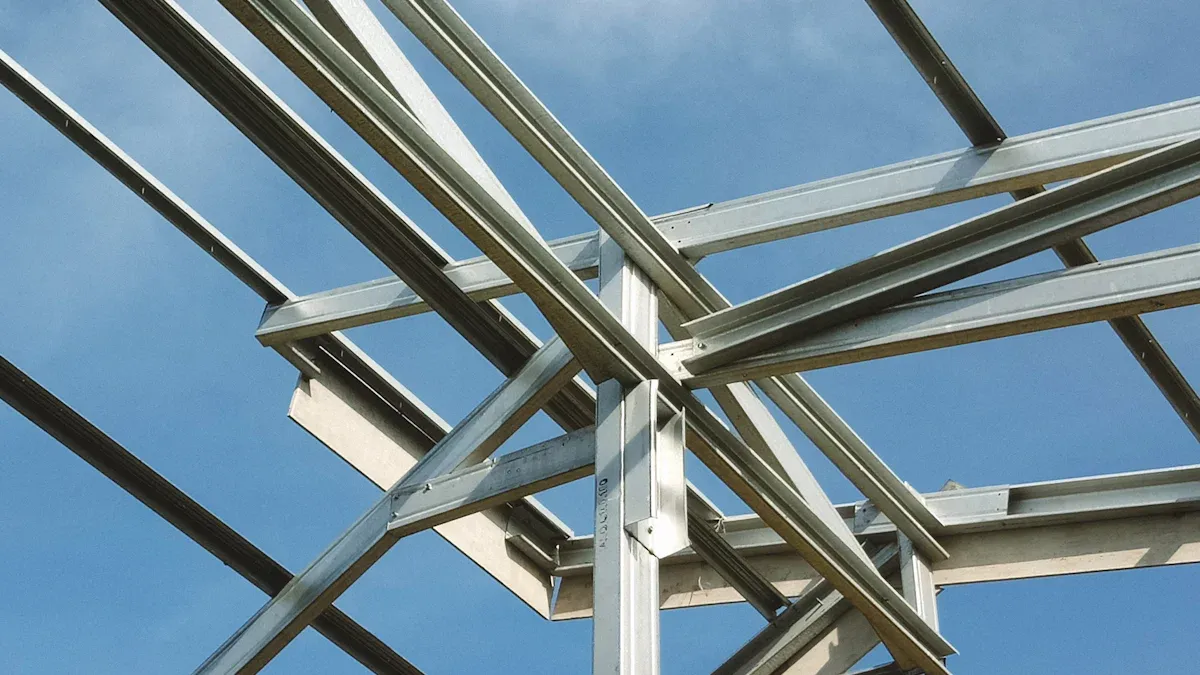
Common Uses of H-Beams
Industrial and commercial construction
H-beams play a vital role in industrial and commercial construction. Their h-shaped steel design provides exceptional strength and stability, making them ideal for large-scale projects. You often see H-beams used in factories, warehouses, and skyscrapers, where load-bearing capacity is critical. These beams also excel in marine applications, such as shipbuilding and offshore platforms, due to their ability to withstand heavy loads and harsh environments.
| Application Category | Description | Growth Trend |
|---|---|---|
| Marine | Dominant category due to demand for robust structural solutions in shipbuilding and offshore construction. | Increased investments in marine infrastructure due to global trade growth. |
| Heavy Machinery | Fastest-growing category driven by demand for sturdy components in construction, mining, and manufacturing. | Essential for heavy machinery frames and supports. |
Bridges and heavy-load structures
H-beams are the backbone of bridges and other heavy-load structures. Their wide flanges and thick web distribute weight evenly, ensuring stability under immense pressure. These beams can span long distances without additional support, making them perfect for bridge decks and piers. Their durability also makes them suitable for high-traffic areas and heavy machinery installations.
Common Uses of I-Beams
Residential construction
I-beams are a popular choice for residential construction. Their lightweight design and cost-effectiveness make them suitable for small to medium-sized buildings. You can find I-beams in floor joists, roof supports, and horizontal beams in multistory homes. These steel beams provide sufficient strength while reducing the overall weight of the structure, ensuring safety and efficiency.
| Feature | I-Beams |
|---|---|
| Weight | Lightweight |
| Cost | Economical |
| Applications | Residential and light industrial |
| Structural Support | Suitable for small to medium-sized buildings |
Lightweight structural projects
I-beams excel in lightweight structural projects. Their design optimizes material usage, making them ideal for frameworks in light-framed houses and small industrial buildings. You can use I-beams as main horizontal supports or in areas where vertical load-bearing columns are necessary. Their versatility and affordability make them a practical choice for various lightweight applications.
- I-beams are commonly used in horizontal beams and support structures for residential buildings.
- They are suitable for floor joists in multistory residences and light-framed houses.
Choosing the Right Beam for Specific Projects
When to choose H-beams
H-beams are the best choice for projects requiring high load-bearing capacity and durability. You should use them in industrial buildings, bridges, and marine structures where stability and strength are essential. Their h-shaped steel design ensures even weight distribution, making them reliable for heavy-duty applications.
When to choose I-beams
I-beams are ideal for lightweight and cost-sensitive projects. You should consider them for residential construction and small-scale industrial buildings. Their lightweight design reduces material costs while providing adequate support for vertical loads. I-beams are perfect for projects where minimizing weight is a priority.
Performance Comparison: H-Beams vs I-Beams
Strength and Load Resistance
H-beam performance under heavy loads
H-beams, with their h-shaped steel design, excel in handling heavy loads. Their wide flanges and thick web provide a higher strength-to-weight ratio, making them ideal for large structures like bridges and industrial buildings. This design allows the beam to resist bending and shear forces effectively, ensuring stability under immense pressure. You can rely on H-beams for projects requiring both vertical and lateral load resistance. Their ability to distribute stress evenly across the structure enhances their durability and reduces the risk of deformation.
I-beam performance under heavy loads
I-beams, while lighter, are better suited for vertical load applications. Their narrower flanges and thinner web make them less effective against lateral forces. This design focuses on optimizing material usage, which reduces weight but limits their strength-to-weight ratio. I-beams perform well in lightweight structures, such as residential buildings, where vertical pressure is the primary concern. However, they are more prone to lateral buckling and twisting under heavy loads, which restricts their use in high-load environments.
Cost-Effectiveness
Cost of manufacturing H-beams
The manufacturing process for H-beams involves specialized machinery to achieve their precise h-shaped steel profile. This complexity increases production costs but ensures superior structural properties. H-beams are an investment for projects requiring long-term durability and high load resistance. Their ability to span long distances without additional support can also reduce overall construction costs in large-scale projects.
Cost of manufacturing I-beams
I-beams are produced using a simpler process, which makes them more affordable. Standard rolling mills shape the steel into the I-profile, reducing manufacturing time and costs. This cost-effectiveness makes I-beams a popular choice for budget-conscious projects. You can use them in lightweight structures where the focus is on minimizing expenses while maintaining adequate strength for vertical loads.
Longevity and Maintenance
Durability of H-beams over time
H-beams offer exceptional durability due to their robust design. Their wide flanges and thick web resist deformation, even under heavy loads. This makes them a reliable choice for long-term projects. The h-shaped steel structure also minimizes stress concentration, reducing wear and tear over time. You can expect H-beams to maintain their structural integrity with minimal maintenance, even in demanding environments.
Durability of I-beams over time
I-beams, while durable, require more maintenance in high-stress applications. Their thinner web and flanges make them more susceptible to wear, especially under lateral forces. For lightweight projects, I-beams provide sufficient durability. However, you may need to inspect and reinforce them more frequently in environments with heavy or dynamic loads to ensure long-term performance.
Understanding the differences in the h beam vs i beam comparison helps you make informed decisions for your projects. H-beams and I-beams differ in shape, strength, and applications. H-beams excel in heavy-duty projects like bridges and industrial buildings, while I-beams suit lightweight structures such as residential homes. Choosing the right beam ensures safety and efficiency. For high-load environments, H-beams provide superior durability. For cost-effective, lightweight designs, I-beams are the better option. Evaluate your project’s needs carefully to select the most suitable beam.
FAQ
What is the main difference between H-beams and I-beams?
H-beams have wider flanges and a thicker web, making them stronger and better for heavy loads. I-beams, with narrower flanges and a thinner web, are lighter and more cost-effective. Choose H-beams for durability and I-beams for lightweight projects.
Which beam is better for residential construction?
I-beams are better for residential construction. Their lightweight design and cost-effectiveness make them ideal for small to medium-sized buildings. They provide sufficient strength for vertical loads while reducing overall material costs.
Can H-beams span longer distances than I-beams?
Yes, H-beams can span longer distances. Their wide flanges and thick web distribute weight evenly, allowing them to handle heavy loads over extended spans without additional support. This makes them suitable for bridges and large industrial structures.
Are H-beams more expensive than I-beams?
H-beams are generally more expensive. Their manufacturing process is more complex, requiring specialized machinery. However, their superior strength and durability make them a worthwhile investment for heavy-duty projects.
How do I choose between H-beams and I-beams for my project?
Consider the load requirements and budget. Use H-beams for heavy loads and long spans, such as bridges or industrial buildings. Opt for I-beams for lightweight, cost-sensitive projects like residential construction or small frameworks.


